


By Edgar Castillo, Contributor at Wild Nexus.
Crossing fences has never been easier.
The most common obstacle encountered by bird hunters in the field is fences. Barbed-wire cattle fences, to be exact. They stand erect as wire barriers, keeping people, ungulates, and unwanted critters in and/or out. They are a normal part of navigating fields and woodlots, and sometimes simply offer up a natural pathway to walk along. Some are void of brushy cover, while others offer a plethora of bird hunting opportunities – brambles, weedy tree lines, and my favorite, plum thickets. Here in the Midwest, barbed-wire fences are a good place to find pheasants and bobwhite quail. Often, fences must be crossed to chase birds and get to new hunting grounds.

Barbed-wire fences can be difficult to cross, or easy. They offer unique challenges in that they can be hazardous. Gashes, cuts, and lacerations do occur when crossing; however, ripped pant crotches are worn as a sort of badge of “dishonor” and embarrassment that brings snickering by fellow compadres. How many times have you observed or partaken in pushing down or pulling up fence strands to climb over? Probably a lot. After a while, those fences will start to sag, offering up an effortless way to cross over. Most hunters innocently don’t think about the damage being done. The landowner will likely have to replace or repair the fence.
Wingshooters have two choices. They can take a long detour and walk until a gate crossing is found (highly unlikely), or climb over or crawl under the fence. However, there is an easier, workable solution that involves a bit of trust in a tool and some steadiness. The T-Post Fence Step, also known as a Hi-Stepper, is a little-known, high-strength aluminum gizmo that has been used for years by ranchers, farmers, surveyors, and yes, even a few hunters.
The device measures 8” in length, 2.25” in width, and 1” in thickness, and weighs a mere 9.3 oz. The T-Post Fence Step is placed on a post only one way, at the preferred height, along the spine, and held in place or “locked in” with the studs or nubs that prevent the barbed wire from sliding up or down the post. This placement creates a gripped step for safely crossing fences.
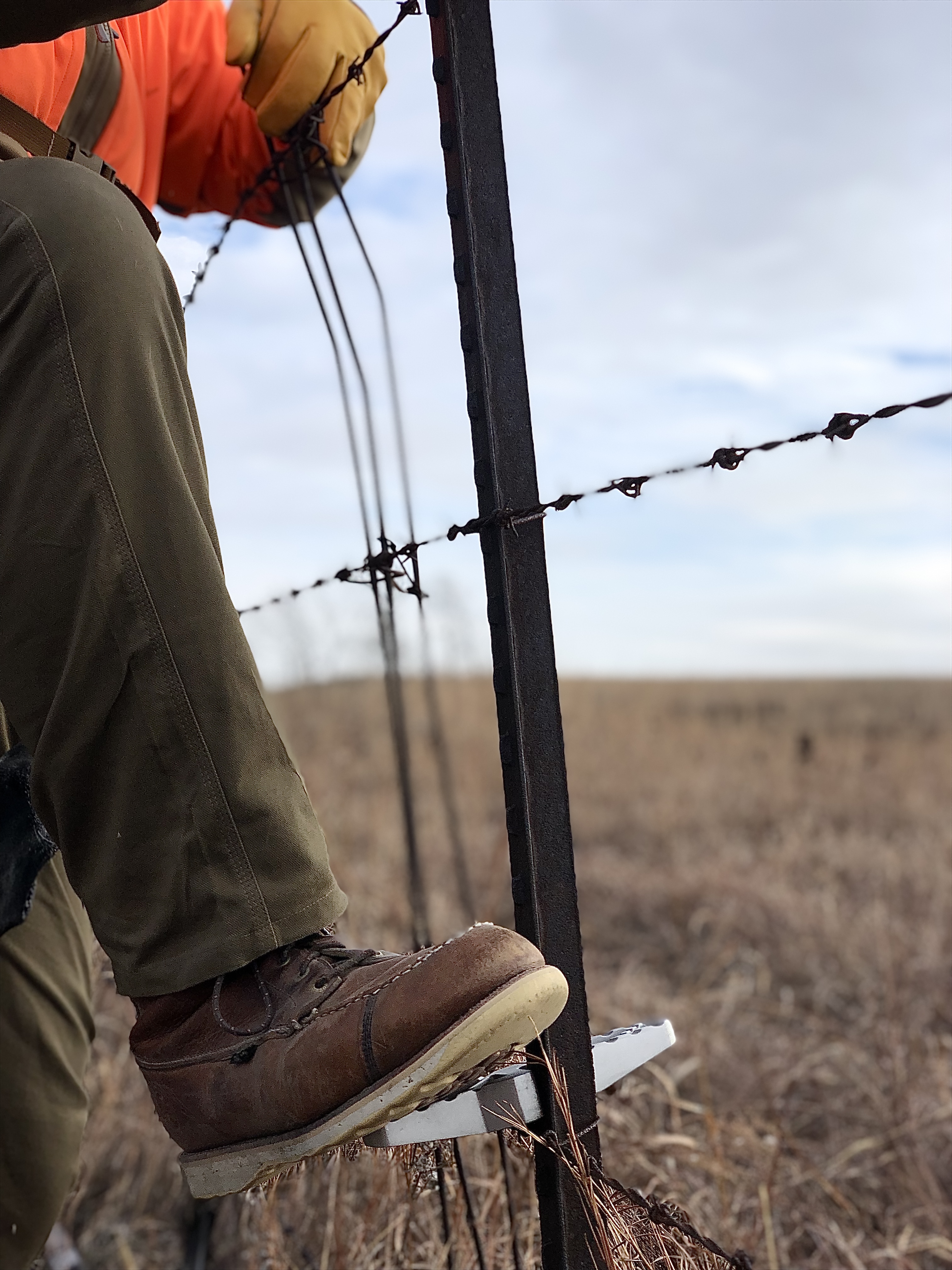
Safety Notes: Always check the condition and stability of the fence before crossing. Practice hunter safety and unload or break open all shotguns prior to crossing a fence.
USING THE T-POST
- Place the left foot onto the T-Post Fence Step.
- With both hands, grab onto the T-Post (preferably using the included cap if available, or wear gloves).
- Carefully step up and slowly swing the opposite leg over.
- Place the right foot onto the other side of the fence step.
- Placing your weight down, it will naturally lock into place and slightly shift the fence step.
- With the right hand, reach out in front of you and carefully and firmly grab onto the top fence wire.
- Kick the left leg over until you are firmly on the ground on the other side.
DESCRIPTION
- Affordable.
- Easy to use.
- Adjustable.
- Secures to almost any T-Post, allowing the user to “step over” for safe fence crossings.
- Lightweight and compact for a variety of hunts, including backcountry.
- Durable, corrosion-resistant aluminum.
- Includes a black nylon storage pouch that can be attached to a belt or stored in a pack or bird vest.
- Some T-Post Fence Steps come with a black or orange plastic protective cap to be placed on the T-Post to protect the hands. The included nylon carrier can also be used and placed over the T-Post.
I received the T-Post Fence Step as a gift during the latter part of 2021. I had heard rumors of such a contraption but had never seen one in action. Blogs, message boards, and forums had both positive and negative things to say about the T-Post Fence Step. However, the majority of the comments and experiences were very favorable. Within days, the T-Post Fence Step was safely used to cross over several fenced properties enrolled in the state’s public access walk-in program. It was easily deployed multiple times across the Kansas and Midwest landscape while hunting prairie chickens, bobwhite quail, and rooster pheasants. Years have passed, and the T-Post Fence Step continues to be used to cross public lands while chasing desert quail in the Southwest, fence lines in Montana, and Wyoming for western prairie birds.
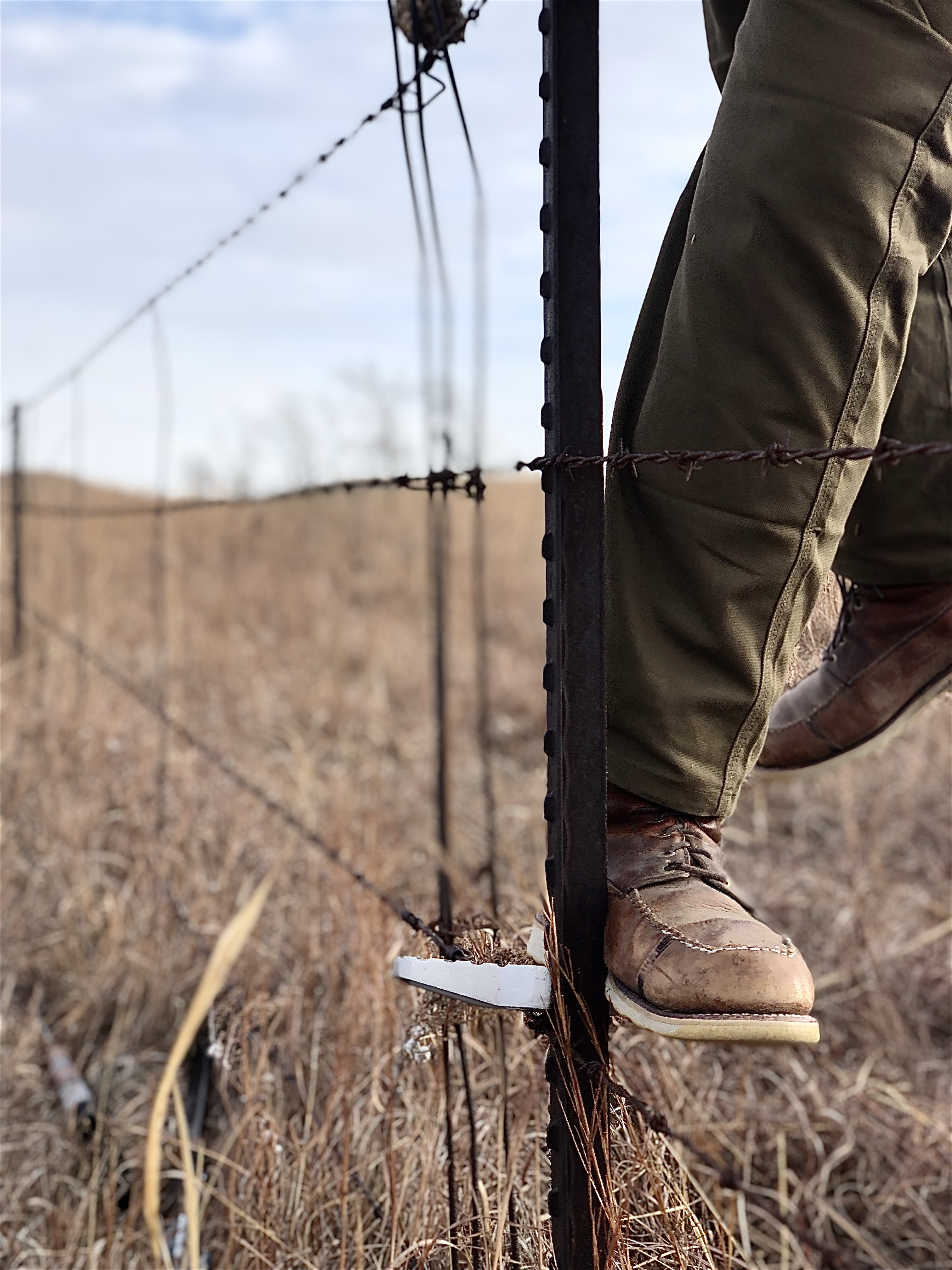
I have found the T-Post Fence Step to be quite a handy tool and useful in many fence-crossing situations when properly used and secured. As with anything, instructions should be strictly followed to make sure the step’s integrated slot secures to the T-Post stud and is assessed before climbing over. The T-Post Fence Step’s success rate has made it a permanent fixture in my bird vest, allowing me to clamber over fences safely to chase wild birds.