
By Johnny Vesper, Contributor at Wild Nexus
Find yourself on a steep sidehill, slick and damp, the ferns spattered with droplets of morning dew, the sun not high enough yet to lift the cold heaviness of night from the creek bottom below, and an enchanting fog blanketing the mountains like a dream lingering— here the cars, lights and noise of the city are easily forgotten. Of course, for those of us who live in town, nothing fills us with feelings of contented freedom more than retreating to the peaceful, remote ruggedness of our favorite backcountry public land hunting spot. But as a friend once rather poignantly said, “I would not trade fighting giant stripers in the ocean, for fishing the neighbor’s bass pond…But when I can’t make it to the coast, the bass pond can sure scratch the itch!”
This perfectly describes my personal sentiment toward suburban deer hunting. Born and raised on the outskirts of Philadelphia- though my soul resides in far away places where the wild things are -life has continued to restrict me in proximity to one of the largest metropolises in America. And as is common with most hunters, opportunities to visit the woods are often limited to short distances from home. Throughout the workweek, I never discount a short window of free time to sneak away to my tree stand, which is in the middle of these bustling Philadelphia suburbs. And as I discovered this fall, the suburbs can unexpectedly hold even trophy class buck that make all the headaches of hunting near town worthwhile.

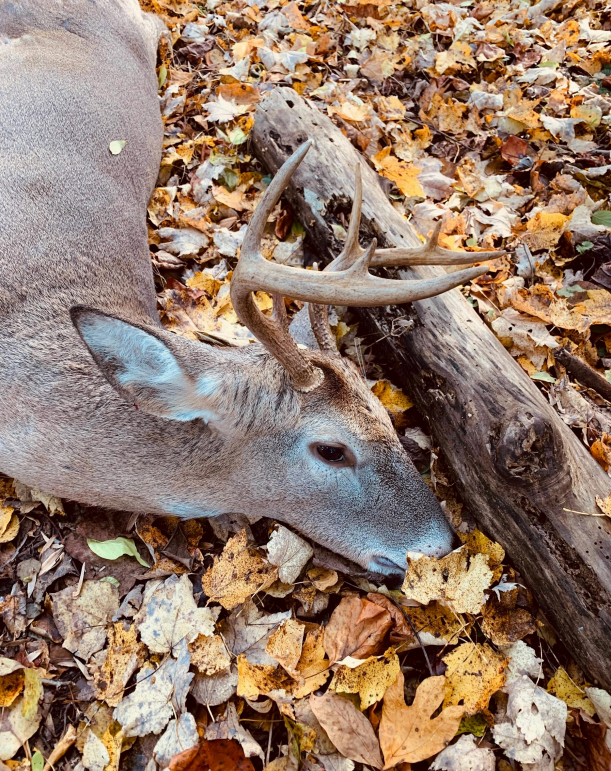
(I arrowed this big bodied 145-inch beast on November 10th. He would have easily scored 150-plus if not for his unusual lack of brow tines. But regardless of the missing brow tines, he is a very respectable archery buck by any honest bow hunter’s estimation.)
Here are a few things to keep in mind when deer hunting close to town.
Different regulations for these highly populated areas
Due to high human population, along with higher-than-average deer density, these suburban areas can carry specific, special regulations, differing from the rest of the state. One thing many casual wildlife observers may be surprised to learn is that whitetail deer do amazingly well making a living close to humans. In fact, as the population of North America has grown, so too, interestingly, has the whitetail population. Humans have historically had a propensity for removing predatory competitors, as well as growing crops, and even contemporarily, planting ornamental landscaping flora, which together provide relative safety along with an abundance of food for deer. This combination has resulted, by some estimations, in an even larger population of whitetail deer then when the first European settlers began sustained colonization in North America. What this means for suburban deer hunting is, often longer seasons, albeit with stringency on method of take. For example, in our “special regulation area” in the Philadelphia region, we enjoy an extended deer hunting season while also enduring a prohibition on the use of centerfire rifles. Be sure to learn the unique regulations of your local suburban hunting spot.
Getting permission and finding the right spot
Finding spots to hunt near town can be difficult. Head to the backcountry and you generally leave behind fences, property lines, and the need for private land permissions where hunting access can transition abruptly between go and no-go in a moment. This is where doing your leg work ahead of time can seriously pay off. And there is no need for accessing large plots of land here. I have taken plenty of deer off suburban properties as small as just a few acres. That said, the smaller the property, the more important it becomes to make friends with the neighbors, particularly when it comes to retrieving your downed quarry. You may not have permission to hunt the neighbors place, but you will at least need the green light from them to retrieve and subsequently complete your successful take. Also, I have found that even a small property can be very productive. Find a place with a few acres, a creek crossing, a pinch point, or a natural suburban wildlife travel corridor, and you will likely enjoy plenty of shot opportunities, as loads of deer are funneling through or being held there in the midst of the hustle and bustle of civilization.
Managing the unique challenges of the unpredictable nature of “folks”-
On the November morning when I shot my first suburban archery buck, things were lining up perfectly. The wind was right, the rut was in full swing, a cold front was approaching, and all the conditions for deer movement were there. I got in the treestand extra early that morning, climbing the icy metal ladder with extra deftness and cautionary care. It was well before sunrise, and I could still see the light above the
neighbors garage door shining brightly through the bare branches of the trees. Just as the sun began to break on the horizon, I saw movement beneath that light over the garage. The door opened, and a man emerged pushing a small, gas-powered lawn mower. He fiddled around with it for a bit, and to my chagrin, exactly when I was sure deer would be filing out of the thicket beneath the trees- the man yanked on the pull start of the old mower. The motor began to whir a deafeningly loud chug under the circumstances, and I knew my perfect hunt was over. But I had the whole morning free, so I stayed put, trying not to be too distracted by the frustrating drone of the man’s domestic duties. Eventually, he finished and headed inside, to presumably take his now late morning coffee, no doubt feeling well accomplished, and surely having no idea of his inconveniencing my hunting plans. It was around 10:30am then, and to my utter amazement, minutes later a perfectly acceptable basket-rack 8 pointer crept from the shadows of the undergrowth. My earlier incredulousness at seeing any deer at all must have dulled my nerves, and I made a perfect heart shot. The moral of this story- the typical rules and norms of backcountry public land hunting do not apply here in the burbs. These deer live with a highly habituated sense of people. Although the sound of power tools, cars, or even the scent of humans will as always heighten their instinctual alarm, it does not necessarily mean they will instantly disappear into the next county. In fact, the limited natural habitat near town means they do not always have far they can go anyway. They will surely, in general, avoid people, and in my case that day, the deer were certainly staying bedded down, waiting to move until after the neighbor headed back inside. But once the coast was clear, my buck was back moving through his typical routine as usual. Be ready to work around these obstacles and remember the rules here are different.
It is always better to go out than to stay in
My current suburban hunting spot is slightly farther from town now, yet still within about a thirty-minute drive of Philadelphia, and only a few miles from one of the largest University campuses in the state. Roads, cars, and neighbors walking dogs— all the usual town-hunting issues exist. But after a few years of patterning the deer movement on this property, and finding workarounds for similar challenges to those I previously described from my first suburban buck, I was able to harvest my biggest and oldest deer to date this season.

Remember, no hunting opportunity is a waste of time. There are things to learn, experiences to be had, and fun to be had. Don’t overlook that woodlot in the back of your cul-de-sac, or the thicket at the back of your buddy’s yard, or the meadow on the friend’s restored historic farmhouse property- If nothing else, it can sure scratch the itch.


Leave a Reply